
Marcus Julius Zanon – Strategic IP & Market Entry Intelligence
In December 2025, Brazil’s Superior Tribunal de Justiça (STJ) issued a ruling with immediate and structural consequences for global pharmaceutical portfolios.
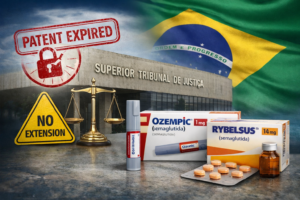
In REsp 2.240.025/DF (official STJ decision), the Court confirmed that patents covering Ozempic® and Rybelsus® cannot be extended, even in the presence of prolonged examination delays at the Instituto Nacional da Propriedade Industrial (INPI).
This ruling consolidates Brazil’s post-2021 patent framework in unequivocal terms:
In Brazil, Patent life is fixed, predictable, and non-negotiable — even for blockbuster medicines.
The dispute involved patents held by Novo Nordisk covering its GLP-1 medicines:
Ozempic®
Rybelsus®
Novo Nordisk argued that excessive administrative delay at the INPI justified a judicial adjustment of the patent term, seeking up to twelve additional years of exclusivity to offset alleged economic losses.
The STJ rejected the claim in full.
The Court’s reasoning is firmly anchored in the binding precedent of Brazil’s Supremo Tribunal Federal (STF), established in ADI 5.529, which:
Declared unconstitutional the automatic patent-term extension mechanism
(Article 40, sole paragraph, Industrial Property Law)
Reaffirmed the constitutional temporariness of patent protection
Explicitly prioritized public health, competition, and legal certainty
The STJ emphasized a decisive constraint:
Brazilian law does not authorize any form of case-by-case judicial patent term adjustment.
Absent statutory criteria, judicial creativity is not an option.
A critical clarification for rights holders:
Brazilian patent law already ensures robust retroactive economic protection.
Under Article 44 of the Industrial Property Law, patentees may seek indemnification for unauthorized use occurring from the publication of the patent application, not merely from the date of grant.
The STJ was explicit and categorical:
Financial compensation exists; prolonged exclusivity does not.
This ruling is not product-specific.
It establishes a structural strategic baseline for all pharmaceutical and life-science portfolios targeting Brazil.
❌ Brazil is no longer a backlog-compensation jurisdiction
✅ Patent expiry dates are fully predictable and enforceable
⚠️ Late-cycle exclusivity strategies must move away from term extension
In practical terms, Brazil now functions as an early-warning market for generic and biosimilar entry, rather than a delayed-access jurisdiction.
From an IP-intelligence perspective, this case confirms a fundamental shift:
Brazil now rewards timing discipline, not procedural patience.
Winning strategies in Brazil after ADI 5.529 rely on:
Secondary patent density (formulations, delivery systems, combinations)
Freedom-to-Operate (FTO) mapping aligned with real expiry dates
Litigation-ready indemnification and damages models
Trademark strategy and market-entry sequencing
Regulatory and data-exclusivity intelligence, where applicable
Patent term extension is no longer a strategic variable in Brazil.
For executives, legal, and regulatory teams, the ruling delivers something increasingly rare:
Certainty.
Clear and reliable entry windows for competitors
Transparent pricing-pressure timelines
Reduced litigation noise surrounding patent duration
Alignment with global public-health and competition standards
In Brazil, the patent clock is now absolute.
The STJ decision in REsp 2.240.025/DF confirms that Brazil has definitively closed the door on judicial patent term extensions — unless and until Congress legislates otherwise.
For GLP-1 drugs and beyond, exclusivity planning must now be front-loaded, data-driven, and jurisdiction-specific.
This is not a loss of protection.
It is a demand for better strategy.
This article is provided for strategic, informational, and educational purposes only and reflects an IP and market-entry intelligence analysis based on publicly available judicial and regulatory information, including REsp 2.240.025/DF (STJ).
It does not constitute legal advice, regulatory advice, or a formal legal opinion, nor does it create an attorney–client relationship. Decisions regarding patent strategy, litigation, regulatory submissions, pricing, or market entry should be made only after consultation with qualified professionals and a fact-specific assessment of the relevant portfolio.
While reasonable efforts have been made to ensure accuracy, no warranty is given as to completeness, timeliness, or applicability. Judicial interpretation, regulatory practice, and market conditions may change without notice.
Use of this material is at the reader’s own risk.