
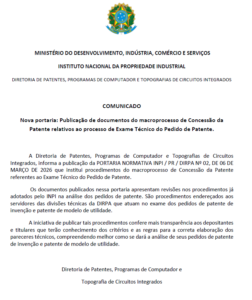
The publication of INPI/PR/DIRPA Normative Rule No. 02, of March 6, 2026, in RPI No. 2879, deserves close attention from patent applicants, rights holders, law firms, technology transfer offices, and innovation teams operating in Brazil. According to DIRPA’s own communication, the rule institutes procedures within the patent grant macroprocess related to the technical examination of patent applications, revises procedures already adopted by the INPI, and seeks to provide greater transparency to applicants and owners regarding the criteria and rules used in technical opinions.
That is important not merely because a new rule has been published, but because the publication gives the market a clearer view of how the Brazilian Patent Office structures technical examination in practice. Instead of leaving this logic largely internal, the INPI has made public a set of operational documents that help applicants and practitioners better understand how patent applications for inventions and utility models are examined.
Normative Rule No. 02/2026 publishes nine documents related to the patent grant macroprocess. These include the instruction for completing the search report, the first examination procedure, the second examination procedure, the treatment of third-party submissions, and procedures linked to preliminary requirements 6.21, 6.22, and 6.23. The rule also expressly revokes INPI Rule No. 10/2021 and INPI/DIRPA Rule No. 03/2022, replacing the prior procedural framework with a revised and consolidated one.
In practical terms, this makes the publication more than a simple administrative act. It operates as a procedural map of the examiner’s expected reasoning, because it clarifies how examination should be structured, documented, and justified. For those involved in drafting, prosecution, office-action responses, and patent due diligence, that added visibility improves predictability and reduces informational asymmetry.
One of the most useful parts of the new publication is the document CPAT-BAN-IT-0001 – Completion of the Search Report. It formalizes how the search report must be filled in within SISCAP, including classification data, databases and tools used, patent and non-patent literature references, and the relevance categories assigned to cited documents.
The relevance coding is especially significant. The search report expressly uses the categories N, I, Y, A, and PN. Category N refers to a document that by itself destroys novelty; I refers to a document that by itself destroys inventive step or inventive act; Y refers to a document that is relevant in combination with one or more others; A identifies general state-of-the-art material without particular blocking relevance; and PN refers to a patent document published after the filing or priority date of the application under examination, but with an earlier filing or priority date, relevant to novelty where there is a corresponding Brazilian filing under Article 11, paragraphs 2 and 3, of the Brazilian IP Act.
This matters because it shows that prior-art analysis is not meant to be generic or intuitive. The INPI is making explicit a more disciplined framework for reading the state of the art. That has direct value for patentability opinions, drafting strategy, claim positioning, and the preparation of responses to substantive objections.
The document CPAT-ETP-PP-0001 – First Examination of a Patent Application is perhaps the most important component of the new rule. It instructs the examiner to identify the invention or utility model, the relevant technical field, the problem in the prior art that the application seeks to solve, and the possible advantageous technical effects or functional improvements. It also states that the examination should be conducted as comprehensively as possible in order to reduce the number of examination rounds before a final decision.
This is highly relevant in practice. It shows that technical examination is not framed merely as a mechanical checklist of patentability requirements. The application is expected to be read through a structured lens: technical problem, proposed solution, technical effect, and relationship to the prior art. As a result, well-drafted applications with internal coherence between the description, claims, and technical contribution are likely to be better positioned in this environment.
Another important point is that the first-examination procedure expressly states the order in which patentability requirements should be examined: industrial application, novelty, and inventive step or inventive act. It further notes that even where one requirement is not met, the following requirements should still be examined unless the issue cannot be overcome through claim redrafting.
Comunicados2879
This is useful because it signals a more exhaustive examination model. The examiner is not expected merely to identify the first defect and stop. Instead, the procedure points toward broader analysis, which means that applicants may face more fully reasoned opinions — and will therefore need more robust, layered responses.
Comunicados2879
The procedure also gives meaningful guidance on Articles 10 and 18 of the Brazilian IP Act. Where the claimed subject matter, as drafted, falls under those provisions, the examiner must assess whether the obstacle can be overcome through changes in wording. Only if that is not possible does the analysis of patentability requirements cease.
Comunicados2879
This is a valuable clarification. It suggests that objections under Articles 10 or 18 are not always treated as immediate dead ends. In some cases, there may still be room for technical and drafting adjustments capable of salvaging part of the claimed matter. That does not guarantee allowance, but it confirms that the examination logic includes a structured opportunity to assess whether the wording can be repaired before the substantive analysis is abandoned.
Comunicados2879
The treatment of Articles 24 and 25 is equally important. The procedure indicates that patentability should not be analyzed, due to insufficiency of disclosure or lack of clarity, precision, or support, only when it has been impossible to carry out a meaningful search. The search-report instruction reflects the same logic by requiring the reasons for a search not being performed to be briefly recorded in the “observations” field, with fuller justification appearing in the technical opinion.
The practical consequence is significant: formal deficiencies do not automatically prevent substantive examination. If a meaningful search remains possible, novelty and inventive-step analysis may still proceed. For applicants, this means that a poorly drafted application may be exposed on both formal and substantive grounds rather than avoiding deeper examination.
The first-examination procedure also offers important guidance on Article 32. Where Article 32 issues arise, the technical opinion must identify both the claim set accepted for examination and the one refused. The substantive analysis must be based on the accepted claim set. Even so, the procedure requires the examiner to evaluate whether the refused claim set contains matter that could support allowance or guide the examination of the earlier claim set, in the interest of procedural economy.
Comunicados2879
This shows that amendment history is no longer just background. Claim-set control becomes part of the examination intelligence itself. For applicants and counsel, that increases the importance of disciplined amendment practice, clear version control, and careful management of claim evolution throughout prosecution.
Comunicados2879
The procedure also places significant emphasis on traceability. The technical opinion must indicate the petition number and date, as well as the pages effectively examined in the specification, claims, drawings, and abstract. Where Article 32 is involved, the traceability must extend to both the accepted and refused claim sets.
Comunicados2879
This matters because it raises the standard for documentary control. For applicants, law firms, and in-house IP teams, version management and procedural organization become more than good practice — they become central to a sound prosecution strategy. The patent application is not just a technical file; it is also a procedural record that must remain coherent and traceable over time.
Comunicados2879
There is also a notable institutional signal embedded in the first-examination procedure. Among the complementary documents appears an instruction entitled “Use of artificial intelligence tools in patent examination activities.” The excerpt reviewed here does not include the contents of that instruction, so no broader conclusions should be drawn beyond what is expressly visible. Still, its inclusion is meaningful.
Comunicados2879
At a minimum, it shows that the use of AI tools is no longer peripheral to the patent-examination environment. The issue has entered the procedural architecture of examination. That does not, by itself, define the substantive impact of AI on decision-making, but it does indicate that governance of AI tools is now formally connected to patent examination operations within the INPI.
Comunicados2879
Taken together, the communication, the rule, and the annexed procedures send a clear message: technical examination of patents in Brazil is being presented in a more structured, traceable, and transparent way. That improves predictability, but it also raises the standard expected from applicants.
Applications that are better aligned in terms of technical problem, disclosure, claims, and amendment strategy are likely to perform better in this environment. On the other hand, vague drafting, weak claim support, poorly controlled amendments, and fragmented responses may face a less forgiving examination landscape. For law firms, technology transfer offices, and companies, this publication is therefore not merely informative. It is an opportunity to refine internal practices and better align prosecution strategy with the procedural logic now made public by the INPI.
INPI/PR/DIRPA Normative Rule No. 02/2026 should be read not only as an act of institutional transparency, but as a meaningful window into the current procedural logic of patent examination in Brazil. By formally publishing the search-report instruction, the first-examination procedure, and other related documents, the INPI has given the market a clearer view of how technical opinions are expected to be structured, documented, and reasoned.
For those working seriously in patents, this is more than an interesting regulatory update. It offers practical guidance for improving application drafting, strengthening amendment strategy, enhancing office-action responses, and reinforcing documentary governance throughout prosecution. In an environment where technical consistency and procedural predictability matter, understanding the examiner’s logic is a genuine competitive advantage.