
Marcus Julius Zanon
IP Lawyer • Industrial Property Agent • Technology Transfer & Innovation Policy Analyst
March 06, 2026.
Brazil possesses one of the most sophisticated institutional innovation systems among emerging economies. Over the past two decades, the country has developed a policy framework that integrates research universities, public funding agencies, industrial policy instruments, and intellectual property institutions to support technological development and industrial modernization.
Although structural challenges remain—particularly limited private-sector investment in research and development and complex regulatory environments—Brazil has built a substantial institutional architecture capable of supporting large-scale innovation initiatives.
For foreign companies, research organizations, and investors, understanding this ecosystem is essential for navigating Brazil’s technology landscape and identifying opportunities for collaboration, investment, and knowledge exchange.
Brazil’s innovation ecosystem is structured around the National System of Science, Technology and Innovation (SNCTI). This system integrates public institutions, universities, research centers, and private companies within a policy framework designed to stimulate technological development.
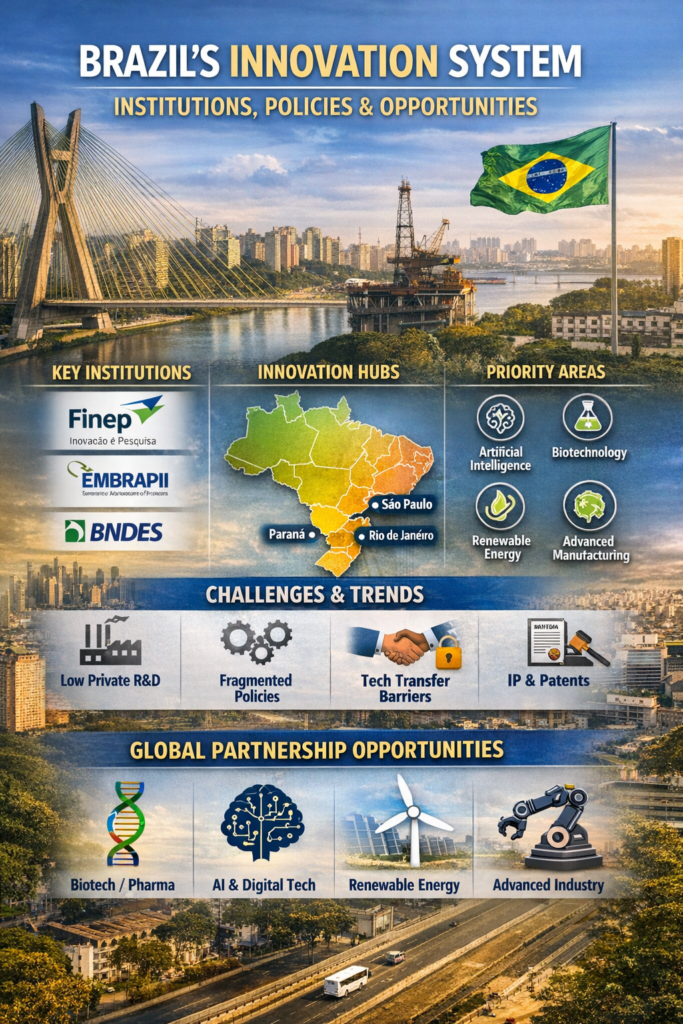
At the federal level, the Ministry of Science, Technology and Innovation (MCTI) coordinates national strategies through programs such as the National Strategy for Science, Technology and Innovation (ENCTI). These policies establish priority areas including artificial intelligence, digital transformation, advanced manufacturing, and biotechnology.
Funding and implementation mechanisms are primarily carried out by institutions such as:
FINEP (Financiadora de Estudos e Projetos), which supports research, development, and innovation projects across the entire technology pipeline.
BNDES (Brazilian Development Bank), which provides large-scale financing for industrial transformation and strategic technological sectors.
EMBRAPII (Brazilian Company for Industrial Research and Innovation), which acts as an intermediary connecting companies with accredited research centers to accelerate applied R&D.
Together, these institutions form the financial and operational backbone of Brazil’s innovation policy.
Brazil’s innovation ecosystem is supported by a comprehensive legal framework designed to encourage collaboration between academia, government, and industry.
Key legislative milestones include:
This law created the legal basis for cooperation between public research institutions and private companies. It also established the concept of Technology Transfer Offices (Núcleos de Inovação Tecnológica – NITs) responsible for managing intellectual property and commercialization of research results.
This reform modernized the regulatory environment by simplifying collaboration mechanisms between universities and industry, reducing bureaucratic barriers to innovation projects.
This law provides tax incentives for companies investing in research and development, allowing deductions for R&D expenditures.
Together, these instruments form one of the most comprehensive legal infrastructures for innovation among emerging economies.
Brazil’s innovation capacity is geographically concentrated in a few regions that combine strong universities, industrial clusters, and technology infrastructure.
The most prominent innovation hubs include:
São Paulo, home to major universities, research institutes, and technology companies.
Santa Catarina, known for its dynamic technology sector and startup ecosystem.
Paraná, with strong industrial and research institutions, including technology centers and innovation agencies.
Rio de Janeiro, where energy, oil, and engineering technologies dominate innovation activity.
These regional ecosystems function as innovation clusters, linking academia, government funding, and private sector research.
Intellectual property plays a central role in transforming scientific knowledge into economic value within Brazil’s innovation system.
The Brazilian National Institute of Industrial Property (INPI) manages patents, trademarks, and industrial designs, providing legal protection for technological innovations.
Effective IP strategies enable:
technology licensing
international partnerships
venture capital investment
commercialization of university research
For companies operating in Brazil, intellectual property protection is increasingly integrated into broader innovation and industrial strategies.
Despite institutional progress, Brazil’s innovation system still faces structural constraints.
Business investment in research and development remains below the average levels observed in OECD countries.
Innovation programs are sometimes dispersed across multiple institutions, complicating coordination.
Public research institutions still encounter administrative hurdles when negotiating licensing and commercialization agreements.
Although improvements have been implemented, patent examination delays historically affected innovation dynamics.
Addressing these challenges is essential for strengthening Brazil’s position in global innovation networks.
Several trends are shaping the next phase of Brazil’s innovation ecosystem.
Recent industrial policy initiatives emphasize advanced manufacturing, digitalization, and sustainability.
Brazil is investing in national AI strategies aimed at expanding research capacity and industrial applications.
The country’s expertise in renewable energy and bioeconomy positions it as a key player in global energy innovation.
Brazil increasingly seeks collaboration with global technology leaders to accelerate innovation.
Brazil’s innovation system offers significant opportunities for international cooperation in areas such as:
biotechnology and pharmaceuticals
artificial intelligence and digital transformation
renewable energy technologies
advanced materials and manufacturing
Foreign companies partnering with Brazilian research institutions can benefit from access to large research networks, public funding programs, and expanding technology markets.
Brazil’s innovation system represents a complex but promising ecosystem that combines public research capacity, institutional funding mechanisms, and evolving industrial policies. While structural challenges remain, the country has developed significant institutional capabilities to support technological development.
For global companies and research organizations, understanding Brazil’s innovation framework is essential to identifying strategic opportunities for collaboration, investment, and technology development.
As innovation becomes increasingly global, Brazil’s research institutions, industrial sectors, and intellectual property infrastructure will continue to play an important role in shaping technological partnerships and knowledge-driven economic growth.
Ministry of Science, Technology and Innovation – National Strategy for Science, Technology and Innovation (ENCTI)
FINEP – Innovation financing programs
BNDES – Industrial and technological development programs
EMBRAPII – Industrial research collaboration model
INPI – Industrial property statistics and reports
OECD – Reviews of Innovation Policy: Brazil
IBGE – PINTEC – Pesquisa de Inovação