
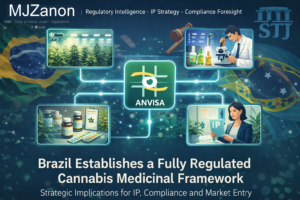
Brazil Establishes a Fully Regulated Cannabis Medicinal Framework — Strategic Implications for IP, Compliance and Market Entry

Brazil Establishes a Fully Regulated Cannabis Medicinal Framework — Strategic Implications for IP, Compliance and Market Entry

Brazil Establishes a Fully Regulated Cannabis Medicinal Framework — Strategic Implications for IP, Compliance and Market Entry

TWS IP AI Tool | Regulatory Intelligence · IP Strategy · Compliance Foresight

On January 28, 2026, Brazil formally entered a new regulatory era for cannabis medicinal products.
The Brazilian Health Regulatory Agency (Anvisa) unanimously approved a comprehensive framework regulating all stages of cannabis production, research and product regularization for exclusively medicinal and pharmaceutical purposes, in direct compliance with a binding decision issued by Brazil’s Superior Court of Justice (STJ) in November 2024.

This decision is not a liberalization measure.
It is a structural regulatory consolidation — and it fundamentally reshapes how IP, compliance and innovation strategies must be designed in Brazil.

From Judicial Authorization to Full Regulatory Control

For years, cannabis medicinal activities in Brazil operated under fragmented rules, exceptional authorizations and judicial pressure. With this decision, Anvisa closes that chapter.

Brazil now adopts a pharmaceutical-grade regulatory architecture, aligned with:

  • International drug-control conventions (UN / INCB)
  • Evidence-based health regulation
  • End-to-end traceability and state oversight

The outcome is a high-certainty, high-barrier market.

The Four Regulatory Pillars Approved by Anvisa

1. Industrial Production: A Pharma-Only Model

Cannabis production is now authorized exclusively for legal entities, subject to:

  • Special Authorization (AE)
  • Prior sanitary inspection
  • Full traceability of inputs, processes and batches
  • Mandatory laboratory analysis of all lots
  • Permanent physical and digital security controls

THC content is strictly limited to ≤ 0.3%, following the STJ ruling.

A permanent interministerial committee (Anvisa, Ministry of Health, Ministry of Justice and Ministry of Agriculture) ensures continuous oversight.

Strategic impact:
Only companies capable of pharma-level compliance, security and auditability can operate. Informal or semi-industrial models are structurally excluded.

2. Research: Cannabis Becomes a Regulated Innovation Asset

Research activities are restricted to:

  • Universities accredited by the Ministry of Education
  • Public Scientific, Technological and Innovation Institutions (ICTs)
  • Pharmaceutical industries
  • State defense bodies

Requirements include:

  • Prior inspection
  • Controlled-access infrastructure
  • 24/7 surveillance systems

Research-derived products cannot be commercialized, but may be shared with other authorized institutions.
THC levels above 0.3% are permitted only via authorized importation, under international control rules.

Strategic impact:
Cannabis is formally integrated into Brazil’s R&D, patent and clinical-evidence pipeline, enabling structured IP generation and technology transfer.

3. Patient Associations: A Controlled Regulatory Sandbox

Anvisa approved a specific instrument for non-profit patient associations, characterized by:

  • No commercial authorization
  • Small-scale, supervised production
  • Selection through public calls
  • Mandatory quality, safety and traceability monitoring

This is not market authorization.
It is a temporary, data-driven regulatory sandbox designed to inform future decisions.

Strategic impact:
The association model is transitional and evidentiary — not a parallel supply chain.

4. Product Regulation: From Exceptional Access to Clinical Evidence

Anvisa also updated RDC 327/2019, closing the gap between access and medicines:

  • The 49 currently regularized cannabis products must now progress toward clinical studies
  • Expanded patient eligibility, including severe debilitating diseases
  • New authorized administration routes:
    • Dermatological
    • Sublingual
    • Buccal
    • Inhalation
  • Advertising strictly limited to prescribers and subject to prior approval

Strategic impact:
The regulatory pathway is now explicit:
product → evidence → registered medicine.

Why This Matters for IP, Compliance and Market Strategy

This framework creates non-negotiable strategic consequences:

Pharma & Biotech

  • Predictable regulatory entry — with high compliance costs
  • Strong incentives for patents, formulations, delivery systems and clinical data
  • Reduced legal uncertainty

Universities & ICTs

  • Secure legal environment for cannabis-based research
  • Clear path to patent filing, licensing and technology transfer

Investors & Market-Entry Teams

  • This is a regulated pharmaceutical market, not an agricultural or lifestyle sector
  • Regulatory barriers reduce volatility and speculation

IP & Compliance Leaders

  • Cannabis medicinal becomes a multi-layer risk domain:
    • Patent landscapes
    • Freedom-to-operate
    • Regulatory surveillance
    • Cross-agency compliance (health, agriculture, justice)

Strategic Interpretation

TWS IP AI Tool classifies this decision as a Tier-1 Regulatory Inflection Point.

It creates:

  • A new patent-dense innovation environment
  • Medium- and long-term FTO and litigation exposure
  • High strategic value for early IP mapping and regulatory intelligence

Organizations that treat this as “news” will react late.
Those that treat it as regulatory infrastructure will shape the market.

Executive Takeaway

Brazil did not open the door to cannabis.
It built a controlled pharmaceutical corridor.

This favors:

  • Science over improvisation
  • Compliance over activism
  • Intelligence over scale

In life sciences, regulation is now the core competitive asset.


How We Can Supports This Market

  • Regulatory intelligence & early-warning alerts
  • Patent and trademark landscape mapping
  • Freedom-to-Operate risk analysis
  • IP + compliance strategy for Brazil & LATAM market entry

Strategic intelligence only — not a formal legal opinion.

Leave a Reply

Your email address will not be published. Required fields are marked *

− 8 = 2